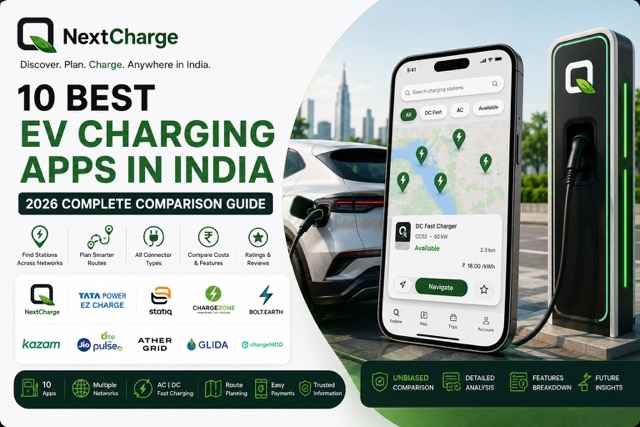
Every EV owner in India eventually asks the same question: "Which app should I actually use to find a charging station?" The honest answer, in 2026, is that no single app has complete coverage of every charging network in the country — so the real question is which combination of apps (or which aggregator) best matches how and where you drive.
This guide compares the 10 most relevant EV charging apps available to Indian drivers today, evaluated on the same set of factual criteria: network coverage, route planning, connector support, charging-speed information, booking and payment capability, and more. We've written this to be genuinely useful whether you're a first-time EV buyer, a fleet manager standardizing on one app, or a researcher trying to understand India's charging-app landscape — not to declare a single "winner" that isn't backed by evidence.
A note on fairness: This article is published by NextCharge, and NextCharge appears in the comparison. Because NextCharge is a pre-launch platform as of this writing, we've deliberately avoided inflating its current capabilities — you'll see "Future Roadmap" labels throughout wherever a feature isn't live yet. The nine other apps are established, operating products, and we've described them based on what's publicly documented about each.
Why Every EV Owner Needs a Charging App
Unlike a petrol station, which you can simply drive up to almost anywhere, EV charging stations are unevenly distributed, connector-specific, and often require an app for both discovery and payment. A charging app typically serves four functions:
- Discovery — showing you where charging stations are located.
- Compatibility filtering — telling you which stations support your vehicle's connector type.
- Navigation — routing you to the station.
- Session management — starting, monitoring, and paying for a charging session (where supported).
Without an app, most public charging stations in India are effectively invisible to a driver who doesn't already know they're there.
Answer box: Why do I need an app to charge my EV in India? Most public EV charging stations in India are only discoverable and usable through an app, because that app handles station location, connector-compatibility filtering, session activation, and payment — functions a petrol station doesn't require.
How EV Charging Apps Work
Most EV charging apps in India follow a similar basic architecture, even though their coverage and feature depth vary widely:
- A station database, either the operator's own network (for single-CPO apps) or aggregated from multiple sources (for aggregator apps).
- A map interface showing stations near the user's location or along a route.
- Filters for connector type, charging speed, and sometimes network or amenities.
- Session initiation, typically via QR code scan, charger ID entry, or in-app "start charging" for apps tied directly to a network's hardware.
- Payment processing, usually through an in-app wallet or linked payment method — for the specific network(s) that app supports.
The key structural difference between apps in this list is simple: single-network apps (like most CPO-branded apps) only show their own operator's stations, while multi-network apps (aggregators) attempt to pull in stations from several operators at once.
How to Choose the Best Charging App
There's no single "best" app for every driver — the right choice depends on your specific situation. Use this checklist:
- Which networks are actually near you? An app is only useful if it covers stations in the areas you actually drive.
- Do you need cross-network coverage, or is one dominant network enough where you live? If one CPO covers your regular routes well, a single-network app may be sufficient.
- Do you take frequent intercity trips? Route-planning and highway-corridor coverage matter more for long-distance drivers than for pure city commuters.
- Does the app support your vehicle's connector type clearly? Not every app labels connector compatibility with the same clarity.
- Do you want one app or are you comfortable using several? This is precisely the trade-off aggregator apps like NextCharge are built to reduce.
Comparison Parameters Explained
Before the rankings, here's exactly what each comparison criterion means, so the table that follows is transparent about what's being measured.
| Parameter | What It Measures |
|---|---|
| Network Coverage | How many charging networks/operators the app's station data includes |
| User Interface | General usability and clarity of the app's design, based on public app-store listings and descriptions |
| Route Planning | Whether the app can plan a multi-stop route with charging stops along the way |
| Filters | Whether users can filter by connector type, charging speed, or network |
| Connector Support | Which connector standards (CCS2, Type 2, CHAdeMO, GB/T, Bharat AC001/DC001) the app documents support for |
| Charging Speed Information | Whether the app shows AC/DC and kW ratings per station |
| Navigation | Whether the app hands off or provides turn-by-turn navigation to a selected station |
| Charging Cost Information | Whether pricing is shown in-app before charging |
| Booking Support | Whether users can reserve a charging slot in advance |
| Live Availability | Whether the app shows real-time station/connector status (available, occupied, offline) |
| Payments | Whether in-app payment is supported, and for how many networks |
| Reviews | Whether the app includes user ratings/reviews of individual stations |
| Reliability | General track record, based on public information — not independently benchmarked by this article |
| Ease of Use | Overall onboarding and day-to-day usability, based on public app-store descriptions |
Top 10 EV Charging Apps in India
1. NextCharge
Overview: NextCharge is a pre-launch Indian startup building a unified EV charging station discovery platform. Its core mission is to aggregate multiple Indian charging networks — including Statiq, Tata Power EZ Charge, ChargeZone, Ather Grid, and Kazam — into a single app, so drivers don't need to check several separate CPO apps to find a compatible, working charger.
Current Features:
- Nearby charging station discovery designed to span multiple networks
- Connector-type and network filtering
- Route-aware discovery built around India's highway and city charging landscape
Future Roadmap (not yet live):
- Live, real-time charger availability
- In-app booking of charging slots
- Unified in-app payments across networks
- AI-assisted route and charging recommendations
- Charging cost estimation and battery range planning
Pros:
- Purpose-built specifically to solve multi-app fragmentation, rather than being a single CPO's own app
- Designed around India's specific charging-network landscape rather than a generic global template
Cons:
- Pre-launch as of this writing — not yet available for public download
- No live-availability, booking, or payment functionality yet
- No independent user reviews or usage track record to evaluate yet, since it hasn't launched
Ideal Users: EV owners frustrated by needing multiple charging apps, who want to be notified when a unified discovery option becomes available.
Supported Networks (planned): Statiq, Tata Power EZ Charge, ChargeZone, Ather Grid, Kazam, and others as integrations develop.
Availability: Early access — not yet publicly launched.
Future Potential: As India's number of independent CPOs continues to grow, the underlying case for an aggregator grows with it — but NextCharge's actual value will depend on how much real network coverage and reliability it delivers once live, which this article will update to reflect honestly.
Early Access: NextCharge is currently in early access.
[EARLY ACCESS]
2. Tata Power EZ Charge
Overview: Tata Power's EZ Charge app is one of the largest and most widely distributed single-network charging apps in India, backed by Tata Power's own charging infrastructure and its role as a partner network in the broader TATA.ev Mega Charger ecosystem. (Source: Tata Power/Tata Motors press materials, 2026.)
Features: Station discovery across Tata Power's own network, session initiation and monitoring, and integration as a partner app within the TATA.ev Mega Charger multi-network initiative.
Pros:
- Large, well-established network footprint across most major Indian cities
- Backed by a major utility with strong infrastructure investment capacity
Cons:
- Primarily focused on Tata Power's own network rather than full cross-network aggregation (outside the specific TATA.ev Mega Charger partnership context)
Ideal Users: Drivers in cities and corridors where Tata Power has strong station density, and Tata EV owners.
Supported Networks: Tata Power EZ Charge network; TATA.ev Mega Charger partner ecosystem.
Availability: Live, publicly available.
Future Potential: Likely to continue expanding alongside Tata Power's broader charging infrastructure investment.
3. Statiq
Overview: Statiq is an independent Indian charge point operator with a strong footprint in premium and commercial locations, particularly around Delhi NCR, and is also a TATA.ev Mega Charger partner network. (Source: Tata Motors press release, 2026.)
Features: Station discovery on Statiq's own network, session management, and premium/commercial-location charging.
Pros:
- Strong presence in high-demand commercial and premium locations
- Established multi-year operating track record
Cons:
- Coverage is strongest in specific regions (notably Delhi NCR) rather than uniformly nationwide
Ideal Users: Drivers frequently charging at commercial, retail, or premium urban locations.
Supported Networks: Statiq's own network; TATA.ev Mega Charger partner.
Availability: Live, publicly available.
Future Potential: Continued expansion as an independent CPO alongside broader industry partnership networks.
4. ChargeZone
Overview: ChargeZone operates public DC fast-charging infrastructure across multiple Indian states and publishes transparent per-unit pricing, publicly stated rates typically fall between ₹18 and ₹25 per unit, shown upfront in its app. ChargeZone is also a TATA.ev Mega Charger partner network. (Source: ChargeZone media page; Tata Motors press release.)
Features: Multi-state DC fast-charging network discovery, upfront pricing display, and session management.
Pros:
- Transparent, publicly documented pricing
- Multi-state DC fast-charging footprint
Cons:
- Like other single-CPO apps, coverage is limited to ChargeZone's own network outside partnership contexts
Ideal Users: Drivers who prioritize DC fast charging and want upfront, predictable pricing.
Supported Networks: ChargeZone's own network; TATA.ev Mega Charger partner.
Availability: Live, publicly available.
Future Potential: Likely continued DC fast-charging expansion given its stated focus.
5. Bolt.Earth
Overview: Bolt.Earth operates EV charging infrastructure in India and is also known for publishing widely cited consumer research and cost-guide content on EV charging economics — content referenced elsewhere on this site.
Features: Charging station discovery and session management on Bolt.Earth's network.
Pros:
- Backed by a company that also invests in EV-charging consumer education and research content
Cons:
- Specific current network size and city coverage were not independently verified for this article — check Bolt.Earth's own app/website for current figures
Ideal Users: Drivers within Bolt.Earth's operating coverage areas.
Supported Networks: Bolt.Earth's own network.
Availability: Live, publicly available.
Future Potential: Not independently assessed for this article.
6. Kazam
Overview: Kazam is notable in the Indian charging landscape for offering a public developer REST API — a comparatively rare feature among major Indian CPOs, most of which require direct bilateral partnerships rather than offering open API access.
Features: Station discovery and session management on Kazam's own network; publicly documented API access for third-party developers.
Pros:
- Open API access is unusually developer-friendly compared to most Indian CPOs
- Makes Kazam more technically accessible for third-party integrations (including aggregators)
Cons:
- Specific current network size and city coverage were not independently verified for this article
Ideal Users: Developers and third-party platforms building on top of charging-network data; drivers within Kazam's coverage areas.
Supported Networks: Kazam's own network.
Availability: Live, publicly available.
Future Potential: Kazam's open-API approach positions it well for continued third-party integrations as India's charging-data ecosystem matures.
7. Jio-bp Pulse
Overview: Jio-bp Pulse is the EV charging network backed by the Jio-bp joint venture (Reliance Jio and bp), combining bp's fuel retail network experience with Jio's infrastructure and digital reach.
Features: Station discovery and session management on the Jio-bp Pulse network, with charging locations often co-located at fuel retail outlets.
Pros:
- Backed by two large, well-capitalized parent companies
- Fuel-retail co-location model provides a familiar, accessible station format for many drivers
Cons:
- Specific current network size and city coverage were not independently verified for this article
Ideal Users: Drivers who prefer charging at familiar fuel-retail-style locations.
Supported Networks: Jio-bp Pulse network.
Availability: Live, publicly available.
Future Potential: Likely to expand alongside bp and Jio's broader fuel-retail-to-EV transition strategy.
8. Ather Grid
Overview: Ather Grid is the charging network operated by Ather Energy, historically built to support Ather's own electric two-wheeler customer base, with charging points concentrated in cities where Ather has strong two-wheeler sales.
Features: Station discovery focused on two-wheeler charging needs, integrated with the broader Ather ownership experience.
Pros:
- Purpose-built for two-wheeler charging patterns and speeds
- Tightly integrated with the Ather ownership ecosystem for Ather customers
Cons:
- Primarily oriented toward two-wheeler use cases and Ather's own city footprint rather than general-purpose four-wheeler charging nationwide
Ideal Users: Ather electric scooter owners.
Supported Networks: Ather Grid network.
Availability: Live, publicly available.
Future Potential: Likely to track Ather's own two-wheeler sales growth and city expansion.
9. GLIDA
Overview: GLIDA (formerly operating under the Fortum Charge & Drive brand in India) is an established charging network and a TATA.ev Mega Charger partner. (Source: Tata Motors press release, 2026.)
Features: Station discovery and session management on GLIDA's network.
Pros:
- Multi-year operating history in the Indian market under its earlier brand
- TATA.ev Mega Charger partner network
Cons:
- Specific current network size and city coverage were not independently verified for this article
Ideal Users: Drivers within GLIDA's coverage areas.
Supported Networks: GLIDA's own network; TATA.ev Mega Charger partner.
Availability: Live, publicly available.
Future Potential: Not independently assessed for this article.
10. chargeMOD
Overview: chargeMOD is an EV charging app and network describing itself as covering 100+ cities in India, with stated presence in states including Andhra Pradesh, Tamil Nadu, Karnataka, and Maharashtra. It supports OCPI-protocol interoperability with other major networks, which it states gives users access to providers including Tata Power, Shell Recharge, and Kazam through the chargeMOD app. (Source: chargeMOD Google Play/App Store listings and official website, 2026.)
Features: Station discovery with Google Maps integration, QR-code or charger-ID session initiation, real-time charging-status monitoring (percentage charged, kWh consumed, power, voltage, current), CCS support up to 350 kW at supported stations, EV-specific route planning ("EV Routing") between destinations, connector-type and charging-speed filtering, and in-app booking and payments. (Source: chargeMOD app store listings, 2026.)
Pros:
- States over 7,000 charging points in its network with Google Maps integration (company-stated figure, not independently verified by this article)
- Documented OCPI-based interoperability with other networks
- Publicly documented booking and payment support within its own app
Cons:
- Network size and interoperability claims are based on the company's own public statements and app-store listings rather than independent verification
- Older app version was deprecated in favor of a newer app in 2023, which may be a relevant consideration for account continuity
Ideal Users: Drivers seeking a single-app experience with booking and payment support across a stated multi-network footprint, particularly in its stronger southern/western India coverage states.
Supported Networks: Its own chargeMOD network, plus stated OCPI interoperability with providers including Tata Power, Shell Recharge, and Kazam.
Availability: Live, publicly available on Google Play, Apple App Store, and Indus Appstore.
Future Potential: Continued growth is plausible given its stated multi-city footprint and OCPI interoperability approach, though this article has not independently verified the company's growth claims.
Comparison Table: 10 Best EV Charging Apps in India (2026)
| App | Coverage | Navigation | Connector Info | Route Planning | Booking | Payments | Live Availability | Reviews Shown In-App | Pricing Shown |
|---|---|---|---|---|---|---|---|---|---|
| NextCharge | Multi-network (planned) | Planned | Yes (planned) | Planned | Future | Future | Future | Planned | Roadmap |
| Tata Power EZ Charge | Own network + Mega Charger partners | Yes | Yes | Not verified | Not verified | Yes (own network) | Not verified | Not verified | Not verified |
| Statiq | Own network + Mega Charger partners | Yes | Yes | Not verified | Not verified | Yes (own network) | Not verified | Not verified | Not verified |
| ChargeZone | Own network + Mega Charger partners | Yes | Yes | Not verified | Not verified | Yes (own network) | Not verified | Not verified | Yes (stated ₹18–25/unit) |
| Bolt.Earth | Own network | Yes | Yes | Not verified | Not verified | Yes (own network) | Not verified | Not verified | Not verified |
| Kazam | Own network | Yes | Yes | Not verified | Not verified | Yes (own network) | Not verified | Not verified | Not verified |
| Jio-bp Pulse | Own network | Yes | Yes | Not verified | Not verified | Yes (own network) | Not verified | Not verified | Not verified |
| Ather Grid | Own network (2W-focused) | Yes | Yes | Not verified | Not verified | Yes (own network) | Not verified | Not verified | Not verified |
| GLIDA | Own network + Mega Charger partners | Yes | Yes | Not verified | Not verified | Yes (own network) | Not verified | Not verified | Not verified |
| chargeMOD | Own network + stated OCPI partners | Yes | Yes | Yes (stated) | Yes (stated) | Yes (stated) | Yes (stated) | Not verified | Yes (in-app) |
"Not verified" means this article could not confirm the specific capability from publicly available sources at the time of writing — it does not necessarily mean the feature is absent. Always check each app's current store listing for the latest feature set. User star ratings are intentionally omitted from this table because they change continuously and this article does not have access to live, verified app-store data — check each app's current Play Store/App Store listing for up-to-date ratings.
Why NextCharge Is Different
NextCharge's differentiation isn't about having more features than the other nine apps in this list today — as a pre-launch platform, it doesn't yet have a live track record to compare. Its differentiation is about what problem it's specifically built to solve: the fact that most of the apps above are single-network apps, requiring drivers to install several of them to get full coverage.
Factually, here's what that means:
- NextCharge focuses on unified charging station discovery — its core design goal is showing stations from multiple networks in one search, rather than building or operating its own physical charging hardware.
- It aims to bring multiple charging networks into one platform — including networks like Statiq, Tata Power EZ Charge, ChargeZone, Ather Grid, and Kazam — rather than competing with them for physical infrastructure.
- It helps reduce app fragmentation — the specific frustration this entire article's comparison table illustrates: nine of the ten apps above are single-network apps by design.
What NextCharge does not yet have, honestly stated:
- No live public availability (pre-launch)
- No live real-time charger availability data
- No booking or unified payment functionality yet
- No independent user reviews or usage history to evaluate
This is deliberately transparent because an inflated comparison would undercut the exact trust this article is trying to build — for NextCharge and for readers trying to make a real decision.
Frequently Asked Questions
1. Which is the best EV charging app in India?
There is no single best app for every driver — it depends on which charging networks operate where you drive, whether you need cross-network aggregation, and whether features like booking or route planning matter most to you. This guide compares the top 10 apps by category so you can choose based on your own needs.
2. Which app supports multiple charging networks?
NextCharge is being built specifically to aggregate multiple networks (currently in early access/pre-launch). chargeMOD publicly states OCPI-based interoperability with providers including Tata Power, Shell Recharge, and Kazam.
3. Can I find nearby charging stations using these apps?
Yes — nearby station discovery is the core function of every app in this list.
4. Which app is best for road trips?
chargeMOD publicly documents EV-specific route planning between destinations. Other apps' route-planning capabilities were not independently verified for this article — check each app's current listing.
5. Which app supports CCS2?
CCS2 support is documented for chargeMOD (up to 350 kW at supported stations) and is generally the dominant DC standard supported across most major Indian CPO apps, though exact per-app documentation varies — verify with each app before relying on it for a trip.
6. Which charging app has the most stations?
chargeMOD publicly states over 7,000 charging points with Google Maps integration. This is a company-stated figure; this article did not independently verify station counts for every app in this list.
7. What is NextCharge?
NextCharge is a pre-launch Indian startup building a unified EV charging station discovery platform designed to aggregate multiple charging networks into one app.
8. Is NextCharge free?
Pricing has not yet been announced, since NextCharge is in early access/pre-launch. Check official NextCharge channels for current information.
9. Can I use one app for every charging station in India?
Not fully, as of this writing. No single app in this comparison has complete coverage of every charging network in India; chargeMOD's stated OCPI interoperability and NextCharge's planned aggregation model are the two approaches in this list specifically aimed at reducing that gap.
10. What is the difference between a single-network app and an aggregator app?
A single-network app (like most apps in this list) only shows its own operator's charging stations. An aggregator app is designed to pull in stations from multiple networks into one search.
11. Does Tata Power EZ Charge work with other networks?
Tata Power EZ Charge is primarily built around Tata Power's own network, and Tata Power is also a partner in the broader TATA.ev Mega Charger initiative alongside other operators.
12. Is Statiq only available in Delhi?
No, but Statiq's strongest documented presence is in premium and commercial locations around Delhi NCR; coverage elsewhere varies.
13. Does ChargeZone show prices before charging?
Yes — ChargeZone publicly states its pricing (typically ₹18–25 per unit) is shown upfront in its app.
14. What connector types do most Indian charging apps support?
CCS2 (DC fast charging) and Type 2 (AC charging) are the most commonly supported standards across major Indian CPO apps, given their dominance among major EV manufacturers.
15. Does Ather Grid work for four-wheelers?
Ather Grid was built primarily around Ather's own electric two-wheeler ecosystem; it is not the primary charging app for four-wheeler EV owners.
16. Is Kazam's API public?
Yes — Kazam is notable for offering a public developer REST API, which is comparatively rare among major Indian CPOs.
17. What is chargeMOD's stated network size?
chargeMOD states over 7,000 charging points across 100+ cities, according to its own app-store listings — a company-stated figure not independently verified by this article.
18. Does chargeMOD support booking?
Yes, according to chargeMOD's own app-store listings, which describe booking charging sessions as a supported feature.
19. What is OCPI and why does it matter for charging apps?
OCPI (Open Charge Point Interface) is a protocol that allows different charging networks to share station and session data with each other, enabling interoperability between apps like chargeMOD and other networks it connects to.
20. Does NextCharge have live charger availability?
Not yet. Live, real-time charger availability is on NextCharge's future roadmap, not a current feature.
21. Can I book a charging slot with NextCharge?
Not yet. In-app booking is on NextCharge's future roadmap.
22. Which app is best for fleet operators?
This article did not independently evaluate fleet-specific features for each app; fleet operators should verify enterprise/fleet support directly with each provider, including chargeMOD (which markets itself partly to fleet managers) and the CPOs relevant to their operating cities.
23. Are user ratings for these apps reliable?
App-store ratings change continuously and can be influenced by many factors; this article does not reproduce specific star ratings, since they would be out of date quickly — check each app's current listing directly.
24. What is a CPO?
CPO stands for Charge Point Operator — a company, like Tata Power, Statiq, or ChargeZone, that owns and operates EV charging stations.
25. Why do so many Indian charging apps only cover their own network?
Because most Indian CPOs built their apps primarily as a customer-facing tool for their own charging hardware, not as a general-purpose discovery platform — which is the specific gap aggregator apps are built to address.
26. Is Jio-bp Pulse connected to fuel stations?
Jio-bp Pulse charging points are often co-located with bp fuel retail outlets, leveraging the existing Jio-bp fuel retail network.
27. What is GLIDA's charging network background?
GLIDA previously operated under the Fortum Charge & Drive brand in India and is a TATA.ev Mega Charger partner network.
28. Does Bolt.Earth only operate charging stations?
No — Bolt.Earth also publishes consumer research and cost-guide content on EV charging economics in India, in addition to operating charging infrastructure.
29. How do I know which connector my EV needs?
Check your vehicle's manual or manufacturer specifications — most modern Indian EVs use CCS2 for DC fast charging and Type 2 for AC charging, but always verify for your specific model.
30. Can I pay for charging directly in these apps?
Most single-network apps in this list support in-app payment for their own network's stations; NextCharge's unified, cross-network payment capability is on its future roadmap, not yet live.
31. What should a first-time EV buyer look for in a charging app?
Coverage in the areas you actually drive, clear connector-type labeling, transparent pricing, and (if you travel frequently) route-planning capability.
32. Does chargeMOD work outside its stated coverage states?
chargeMOD's public materials specifically mention Andhra Pradesh, Tamil Nadu, Karnataka, and Maharashtra among its coverage states; verify current coverage in your specific location via the app.
33. Is there a single official government charging app for India?
This article did not identify a single, universally used, official government-run public charging app as of this writing; charging discovery in India currently happens primarily through individual CPO apps and third-party aggregators.
34. What does "early access" mean for NextCharge?
It means NextCharge has not yet launched a public app; interested users can sign up to be notified when it becomes available.
35. Are there other charging apps in India not covered in this list?
Yes. This list focuses on 10 of the most commonly referenced apps in India's EV charging landscape as of 2026; it is not exhaustive of every regional or niche operator.
36. How often should I check an app for current pricing?
Charging prices can change; always check current in-app pricing before a session rather than relying on previously seen figures, including those cited in this article.
37. Do these apps work for electric two- and three-wheelers, not just cars?
Coverage varies by app — Ather Grid is specifically built around two-wheeler charging, while most other apps in this list are broader multi-vehicle-type platforms; verify per-app compatibility for your specific vehicle type.
38. What's the safest way to evaluate a charging app before relying on it for a trip?
Check current app-store ratings and reviews, verify coverage in your specific route/area directly in the app, and confirm connector compatibility for your vehicle before departure.
39. Will this comparison stay accurate over time?
App features, coverage, and claims change; this guide reflects publicly available information as of mid-2026 and should be periodically re-verified, particularly for a fast-moving list like NextCharge's roadmap and any company-stated network-size figures.
40. How can I contact NextCharge about early access or partnerships?
Use NextCharge's official channels for early-access sign-up and business/CPO partnership inquiries.
Conclusion
None of the ten apps in this comparison is the single "right" answer for every EV driver in India — and any comparison article claiming otherwise, including one published by a company reviewing its own product, would be doing readers a disservice. What's clear across this comparison is the structural pattern: most established Indian charging apps are single-network tools, chargeMOD has built meaningful cross-network interoperability through OCPI, and NextCharge is entering pre-launch specifically to pursue that same aggregation problem from a different angle. Which app — or combination of apps — is right for you depends on where you drive, which networks are near you, and whether cross-network coverage matters more to you than deep, single-network reliability.
Want early access when NextCharge launches its unified charging station discovery app? [EARLY ACCESS]