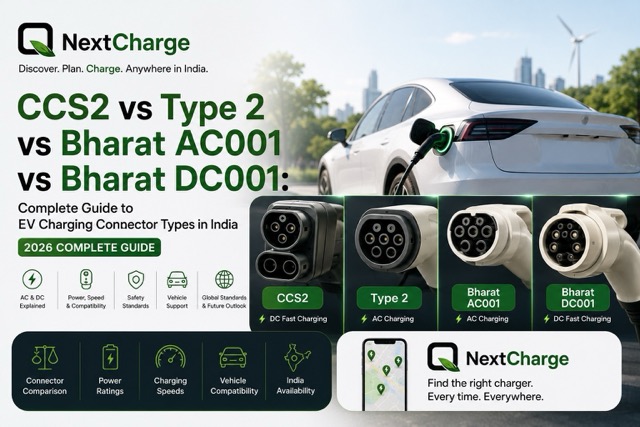
Plug the wrong connector into an EV charging station and nothing happens — not because of a software error, but because the physical shapes don't match. Unlike a phone charger, where a handful of universal cables cover almost every device, EV charging in India runs on multiple parallel connector standards, each with a different shape, a different power range, and a different history. Getting this wrong isn't just inconvenient; it's the single most common reason first-time EV buyers report showing up at a "compatible" charging station and being unable to charge.
This guide is a complete technical reference to every EV charging connector you'll encounter in India: CCS2, Type 2, Bharat AC001, Bharat DC001, CHAdeMO, and GB/T, plus the Tesla/NACS connector as a global reference point. For each, we cover its history, physical design, power and voltage specifications, real vehicle compatibility, and where it stands in 2026. We'll also explain, in plain terms, which connector Indian EV buyers actually need to care about — and which ones are historical footnotes.
Who this is for: EV owners and first-time buyers who want to know what will actually work with their car, fleet operators and charging station operators making hardware decisions, and engineers, students, and researchers who want accurate technical detail rather than marketing simplification.
What Is an EV Charging Connector?
Definition: An EV charging connector is the standardized physical plug-and-socket interface, along with its associated communication protocol, that allows a charger to safely transfer electrical energy into an EV's battery. The connector defines the physical pin layout, the maximum voltage and current it can carry, and how the charger and vehicle "handshake" to negotiate a safe charging session.
Two EVs can both be "electric" and still be physically unable to share a charger, if their connector standards differ. This is why connector type — not just charger location — is the first thing to check before relying on any charging station.
Why Charging Standards Matter
Charging standards exist to solve three problems simultaneously: safety (preventing electrical faults, overcurrent, and unsafe connections), interoperability (letting multiple vehicle brands use the same charging infrastructure), and scalability (allowing charger manufacturers, EV makers, and charge point operators to build compatible hardware independently). In India, these standards are governed primarily by the Bureau of Indian Standards (BIS) through the IS 17017 series, which itself draws on international IEC 61851 standards, alongside India-specific specifications developed by the Department of Heavy Industry (DHI) — namely the Bharat AC001 and Bharat DC001 chargers.
Key takeaway: In India, connector standards aren't arbitrary manufacturer choices — they're governed by BIS standards (IS 17017) and DHI specifications, which is why the landscape, while fragmented, follows documented technical rules rather than ad hoc design.
Difference Between AC and DC Charging
This distinction matters more than any single connector's name, because it determines both charging speed and which part of the vehicle does the electrical conversion work.
- AC (Alternating Current) charging: Power arrives at the vehicle as AC, exactly as it comes from the grid or a home socket. The vehicle's own onboard charger (OBC) converts this AC power into DC power the battery can store. The OBC's capacity — commonly 3.3 kW, 7.2 kW, or 7.4 kW in mainstream Indian EVs — is the real bottleneck, regardless of how powerful the external AC charger is.
- DC (Direct Current) charging: The conversion from AC to DC happens inside the charging station itself, using large-scale power electronics, and DC is fed directly into the battery — bypassing the car's onboard charger entirely. This is why DC fast charging can be dramatically quicker: it isn't limited by the small converter built into the vehicle.
Answer box: What is the difference between AC and DC EV charging? AC charging relies on the vehicle's onboard charger to convert grid AC power to DC, typically limited to 3.3–22 kW; DC charging converts power at the station itself and feeds it directly to the battery, enabling much higher speeds — commonly 30–150 kW at Indian public stations today, with some sites reaching higher.
Complete History of EV Charging Connectors in India
Understanding why India ended up with multiple standards helps explain the current landscape better than any technical spec sheet alone.
- Pre-2017: India's earliest EV charging infrastructure largely followed China's GB/T standard by default, since it was one of the few mature standards available and early Chinese-origin EV components used it.
- 2017: The Department of Heavy Industry (DHI), through the FAME-I scheme, introduced India's own charging specifications — Bharat AC001 and Bharat DC001 — adapted from GB/T with modifications for Indian ambient-temperature conditions and India's early EV fleet (largely low-voltage two- and three-wheelers, plus a handful of low-voltage passenger cars like the Mahindra e2o and e-Verito).
- 2018: BIS published IS 17017-1 in August 2018, formally recognizing the globally established CCS2 and CHAdeMO protocols for higher-voltage DC fast charging, alongside the domestic Bharat standards.
- Early policy mandate (2017–2019): Government charging-station tenders initially required at least one Bharat DC charger per station.
- 2019: As major automakers — Tata, Hyundai, MG, and others — began launching higher-voltage passenger EVs using CCS2, the Bharat DC charger mandate was dropped, and the market shifted decisively toward CCS2 for DC fast charging.
- 2020s–2026: CCS2 (DC) paired with Type 2 (AC) has become the dominant combination across nearly every mainstream Indian EV — Tata, MG, Mahindra, Hyundai, Kia, BYD, and premium European brands alike. GB/T has narrowed mostly to electric buses and a small number of legacy fleet vehicles. Bharat DC001 remains recognized in IS 17017 for low-voltage applications but sees little new deployment. India has also introduced newer light-EV-specific standards (LECCS, including Type 6/Type 7 connectors) aimed at electric two- and three-wheelers, which sit outside the scope of this passenger-vehicle-focused guide.
Connector Evolution Timeline (Text Summary)
| Period | Development |
|---|---|
| Pre-2017 | GB/T-based charging dominant by default |
| 2017 | Bharat AC001 / Bharat DC001 introduced by DHI (FAME-I) |
| 2018 | BIS IS 17017-1 formally recognizes CCS2 and CHAdeMO |
| 2017–2019 | Government tenders mandate at least one Bharat DC charger per station |
| 2019 | Bharat DC mandate dropped as CCS2 adoption accelerates |
| 2020–2026 | CCS2 (DC) + Type 2 (AC) becomes the dominant combination industry-wide |
Connector Types Used in India: Detailed Technical Breakdown
CCS2 (Combined Charging System 2)
History: CCS2 is a European-originated DC fast-charging standard (built around the IEC 62196 Type 2 AC connector, extended with two additional DC pins), formally recognized in India by BIS under IS 17017-1 in August 2018.
Design: CCS2 is a "combo" inlet — the upper portion is a standard Type 2 AC connector, and two larger pins below it carry DC power. A single CCS2 port on a vehicle therefore supports both home/public AC charging and public DC fast charging through one physical inlet.
Power Output: Ranges from roughly 50 kW up to a theoretical 350 kW at the connector-standard level, though most Indian public DC installations today operate in the 30–150 kW range, with a smaller number of premium ultra-fast sites reaching higher.
Charging Speed: A 20–80% charge typically takes 30–45 minutes on a mainstream 30–60 kW DC charger, or 15–30 minutes on a 120 kW+ ultra-fast charger — always subject to the vehicle's own charge-acceptance limit.
Voltage/Current: DC output voltage and current vary by charger hardware, commonly ranging up to several hundred volts DC at ratings matched to the station's kW output (for example, a 60 kW charger commonly operates around 415V AC input, delivering DC output scaled to the vehicle's battery voltage).
Compatible Vehicles in India: CCS2 is used for DC fast charging (and Type 2 for AC) by virtually every modern mainstream and premium EV sold in India, including the Tata Nexon EV, Tata Punch EV, Tata Curvv EV, Tata Harrier EV, MG ZS EV, MG Windsor EV, Mahindra XUV400, Mahindra BE 6, Mahindra XEV 9e, Hyundai Creta Electric, Hyundai Ioniq 5, the BYD range (including BYD Atto 3, BYD e6, and BYD Seal), Kia EV6, and premium European models from BMW, Mercedes-Benz, Audi, and Volvo.
Advantages: Single-port AC+DC design; broadest vehicle support among Indian EVs; scalable to very high power for future vehicles; internationally standardized, simplifying hardware sourcing.
Limitations: Requires more expensive station hardware than AC-only chargers; actual charging speed is capped by the vehicle's own DC charge-acceptance rate, not just the station's rating.
Common Usage in India: The default standard for public DC fast charging at malls, highway plazas, and dedicated charging hubs.
Countries Using It: Widely used across Europe and increasingly standard in India; broadly comparable (with regional variants) to CCS1 used in North America.
Future Outlook: CCS2 is positioned as India's primary DC fast-charging standard for the foreseeable future, with growing deployment of higher-power (120 kW+) units as more Indian EVs adopt 400V and, increasingly, 800V battery architectures capable of accepting faster charging.
Type 2 (IEC 62196 Type 2 / "Mennekes")
History: Type 2, also known as the Mennekes connector after the German company that originally designed it, is the standard AC charging connector recognized under IEC 62196 and adopted in India for home, workplace, and public AC charging.
Design: A 7-pin AC connector supporting both single-phase and three-phase power, with dedicated communication pins that allow the vehicle and charger to "handshake" — verifying compatibility and negotiating charging parameters before power flows, as a safety feature.
Power Output: Type 2 chargers in India typically range from about 3.3 kW up to 22 kW, though most home and workplace installations use 7.2–7.4 kW single-phase units. (Source: MobiLane, Jun 2026.)
Charging Speed: Roughly 25–75 km of range added per hour, depending on the vehicle's onboard charger capacity and the AC charger's power rating.
Voltage/Current: Supports both single-phase (230V) and three-phase (400V) AC supply, depending on the installation and charger rating.
Compatible Vehicles in India: Used for AC charging by essentially every EV sold in India today, from the Tata Nexon EV and MG ZS EV to premium imports like the Audi e-tron and Mercedes EQC — almost always as the AC portion of a combined CCS2 inlet. (Source: Bolt.Earth, Apr 2026.)
Advantages: Universal compatibility across nearly all Indian EVs; built-in safety handshake; suitable for both home and public slow/medium charging; lower hardware cost than DC fast chargers.
Limitations: Charging speed is fundamentally capped by the vehicle's onboard charger, regardless of the external charger's rating; not suitable as the sole charging method for long-distance travel.
Common Usage in India: Home wallboxes, workplace charging, and public AC charging points at malls, offices, and hotels.
Countries Using It: Standard across Europe and widely adopted in India; functionally the AC counterpart used in most CCS2-equipped markets globally.
Future Outlook: Type 2 is expected to remain India's default AC charging standard indefinitely, given its near-universal adoption and its role as the AC half of the CCS2 combo inlet used by nearly all new Indian EVs.
Bharat AC001
History: Bharat AC001 was introduced by India's Department of Heavy Industry (DHI) in 2017 under the FAME-I scheme, as part of India's first domestically defined EV charging specifications, primarily targeting two-wheelers, three-wheelers, and early low-voltage passenger EVs.
Design: A wall-mounted charging unit with three separate industrial plug outputs, allowing it to charge up to three vehicles simultaneously from a single unit. It takes a three-phase AC input and delivers single-phase 230V AC output per connector. (Source: EVreporter, Mar 2024.)
Power Output: Each output delivers a maximum of 3.3 kW at up to 15A charging current.
Charging Speed: Comparable to basic Level 1/entry Level 2 AC charging — suitable for overnight or extended-duration charging rather than quick top-ups.
Voltage/Current: 230V single-phase AC output per connector, maximum 15A current, from a three-phase input supply.
Compatible Vehicles: Designed to charge two-wheelers, three-wheelers, and early Tata and Mahindra electric cars available in India at the time of the standard's introduction.
Advantages: Simple, low-cost hardware; simultaneous multi-vehicle charging from one unit; well-suited to India's large 2W/3W EV fleet.
Limitations: Low power output makes it unsuitable for fast charging of modern passenger EVs; largely superseded by Type 2 for new passenger-vehicle deployments.
Common Usage in India: Legacy government-scheme charging installations and continued relevance for electric two- and three-wheeler charging infrastructure.
Future Outlook: Bharat AC001 remains a recognized standard for low-power, multi-vehicle AC charging (particularly 2W/3W), but is not the standard growth area for passenger-car charging infrastructure, where Type 2 dominates new deployments.
Bharat DC001
History: Bharat DC001 was introduced alongside Bharat AC001 in 2017 under FAME-I, based on a modified version of China's GB/T DC standard, adapted for Indian ambient-temperature conditions. Early government charging-station tenders mandated at least one Bharat DC charger per installed station.
Design: Uses a GB/T-derived rectangular DC connector with two main power pins plus smaller communication pins, communicating over a CAN-bus protocol.
Power Output: Early Bharat DC001 installations delivered up to roughly 200V DC at up to 120A — approximately 15 kW — with commercial charger hardware available today in ratings around 15 kW.
Charging Speed: Significantly slower than modern CCS2 DC fast charging, reflecting its original design for early-generation, lower-voltage EVs.
Voltage/Current: Historically up to 200V DC / 120A on early installations; commercial units today are commonly rated around 15 kW DC output.
Compatible Vehicles: Designed for early Indian EVs including the Mahindra e-Verito, Mahindra e2o, and Tata Tigor EV fleet vehicles.
Advantages: Domestically defined standard suited to India's early, lower-voltage EV fleet; simple CAN-bus communication protocol.
Limitations: Not compatible with CCS2 — a fundamentally different connector shape and protocol; power output far below what modern passenger EVs require or can accept; the government mandate requiring it at new stations was dropped in 2019 as the market shifted to CCS2.
Common Usage in India: Largely limited to older public charging installations from the FAME-I era; new station deployments overwhelmingly favor CCS2 instead.
Future Outlook: Bharat DC001 remains formally recognized in IS 17017 for low-voltage DC applications, but new commercial and public charging investment in India has moved decisively toward CCS2, meaning Bharat DC001's role is expected to keep narrowing over time.
CHAdeMO
History: CHAdeMO is a DC fast-charging standard developed in Japan, one of the earliest DC fast-charging protocols adopted globally, and one of the two DC standards (alongside CCS2) formally recognized under India's IS 17017-1 in 2018.
Design: A dedicated DC-only connector using CAN-bus communication between vehicle and charger.
Power Output: Varies by hardware generation; commonly associated globally with 50 kW-class charging on earlier installations, though newer CHAdeMO revisions support higher power in other markets.
Charging Speed: Broadly comparable to mainstream CCS2 DC fast charging on equivalent-power hardware, though CHAdeMO has a smaller installed base in India specifically.
Compatible Vehicles in India: Used by a smaller number of Japanese-origin EV models available in India historically; India's newer mainstream EV lineup has predominantly adopted CCS2 instead.
Advantages: Mature, well-established global standard with a long safety and reliability track record.
Limitations: Smaller vehicle-model support in India compared to CCS2; requires separate charger hardware/connector guns from CCS2-only stations (though many Indian multi-standard chargers include both).
Common Usage in India: Present at some multi-standard public DC charging stations alongside CCS2, primarily to support older or imported vehicles.
Future Outlook: CHAdeMO is expected to continue supporting existing vehicles in India, but newer EV models are predominantly shifting toward CCS2, and CHAdeMO is not the standard most new Indian EV launches are designed around.
GB/T
History: GB/T ("Guobiao," meaning national standard) is China's national EV charging standard and was the de facto standard used in early Indian charging infrastructure before India developed its own Bharat AC001/DC001 specifications in 2017.
Design: Unlike CCS2, GB/T uses entirely separate connectors for AC and DC — an oval-shaped 7-pin connector for AC, and a rectangular housing with two thick DC pins for DC fast charging.
Power Output: Varies by installation and vehicle generation; used historically for both early passenger EVs and, in India today, most commonly for electric buses.
Compatible Vehicles in India: Today, GB/T in India is used mostly by electric bus fleets — including many BYD and Olectra bus deployments — and some very early legacy fleet vehicles, rather than mainstream passenger EVs.
Advantages: Mature standard with a large installed base historically, particularly relevant for the electric-bus segment.
Limitations: Not compatible with CCS2 — a GB/T charging gun physically cannot connect to a CCS2 vehicle inlet, and vice versa. This incompatibility is a real, practical consideration for fleet operators managing mixed vehicle types.
Common Usage in India: Electric bus charging depots and legacy fleet installations.
Countries Using It: China's national standard, also present in markets with significant Chinese vehicle-component influence.
Future Outlook: GB/T's role in India is expected to remain concentrated in the electric-bus segment rather than expanding into mainstream passenger-vehicle charging, where CCS2 has become dominant.
Tesla Connector / NACS (Global Reference)
History: Tesla developed its own proprietary connector for its vehicles and Supercharger network; in North America, this has since been standardized more broadly as NACS (North American Charging Standard) and adopted by several other automakers in that market.
Design: A compact connector combining AC and DC charging capability in a single, smaller physical footprint than CCS2.
Relevance to India: Tesla's connector/NACS is included here as a global reference point rather than as an actively deployed Indian standard — it is not part of India's mainstream public charging infrastructure landscape as covered by the CCS2/Type 2/Bharat standards discussed throughout this guide. Readers should check current, India-specific sources directly for the latest status of Tesla's presence in the Indian market, since this changes independently of India's charging-standards landscape covered here.
Future Outlook: Not assessed as part of this India-focused connector guide, given its current lack of dedicated Indian charging-standard deployment.
Master Comparison Table: EV Charging Connectors in India
| Connector | Charging Type | Power Rating | Typical Charging Speed | Vehicle Compatibility (India) | Availability in India | Future Support |
|---|---|---|---|---|---|---|
| CCS2 | AC + DC (combo) | Up to ~350 kW (typically 30–150 kW deployed) | 20–80% in 15–45 min (DC) | Nearly all modern mainstream & premium EVs | Widespread, growing | Dominant, strong future support |
| Type 2 | AC | 3.3–22 kW (typically 7.2–7.4 kW) | ~25–75 km/hour | Nearly all EVs (as AC/CCS2 combo) | Universal | Dominant, strong future support |
| Bharat AC001 | AC | 3.3 kW per gun (up to 3 vehicles) | Slow/overnight | Early Tata/Mahindra cars; 2W/3W | Legacy installations, 2W/3W relevant | Stable niche (2W/3W), not passenger-car growth area |
| Bharat DC001 | DC | ~15 kW (historically up to ~200V/120A) | Slow relative to CCS2 | Early Mahindra e2o/e-Verito, Tata Tigor EV fleet | Declining, legacy installations | Narrowing; new deployments favor CCS2 |
| CHAdeMO | DC | Commonly 50 kW-class | Comparable to equivalent-power CCS2 | Smaller number of Japanese-origin models | Present at some multi-standard stations | Supports existing vehicles; not primary for new models |
| GB/T | AC + DC (separate connectors) | Varies | Varies | Electric buses (BYD, Olectra); legacy fleet | Concentrated in bus segment | Stable in buses; not expanding to passenger EVs |
| Tesla/NACS | AC + DC (proprietary/NACS) | Varies (global) | Varies (global) | Not an active Indian standard | Not part of India's mainstream infrastructure | Not assessed for India in this guide |
Safety standards note: All BIS-recognized connectors discussed above (CCS2, CHAdeMO, Type 2, Bharat AC001/DC001) operate under India's IS 17017 series and, for charger-facility-level requirements, AIS 138-1 (AC) and AIS 138-2 (DC), which are themselves adapted from IEC 61851.
Which Connector Is Best?
There isn't a single "best" connector in the abstract — the right answer depends on what you're evaluating:
- For DC fast charging in a modern passenger EV: CCS2 is the clear answer in India today, given its dominant vehicle support and growing infrastructure investment.
- For AC/home charging: Type 2 is effectively the only answer for modern Indian passenger EVs, since it's built into the same CCS2 combo inlet nearly every current EV uses.
- For electric two- and three-wheelers: Bharat AC001 (and India's newer LECCS standards, outside this guide's scope) remain relevant, given the segment's different power and cost requirements.
- For electric buses and select legacy fleets: GB/T remains the practical standard in active use.
Which Connector Should Indian EV Buyers Choose?
For virtually any new passenger EV purchase in India today, this isn't really a choice — nearly every mainstream and premium model sold uses Type 2 for AC and CCS2 for DC as a combined inlet. The practical question for buyers isn't "which connector should I choose," but "does my home/workplace charger and the public network near me support Type 2 AC and CCS2 DC" — which, for the large majority of Indian buyers today, it does.
Which Connector Is Future-Proof?
CCS2 paired with Type 2 is the combination infrastructure specialists currently consider the safest, most future-proof choice for new charging station investments in India, given CCS2's scalability to very high power ratings and its dominant adoption among major EV manufacturers. (Source: TelioEV, Nov 2025.)
Which Charging Connector Is Most Common in India?
Type 2 (for AC) and CCS2 (for DC) are, combined, by far the most common connector types in India's current EV charging landscape, supported by essentially every mainstream and premium passenger EV sold in the country as of 2026.
Vehicle-Specific Connector Compatibility
| Vehicle | AC Connector | DC Connector | Notes |
|---|---|---|---|
| Tata Nexon EV | Type 2 (up to ~7.2 kW) | CCS2 (up to ~60 kW on current generation; earlier generations around 25 kW) | Best-selling EV in India historically; specifications vary by model year |
| MG ZS EV | Type 2 (~7.4 kW OBC) | CCS2 (up to ~90 kW) | (Source: ev.care, Jun 2026) |
| Mahindra BE 6 | Type 2 | CCS2 | (Source: OnePlug EV; RIOD, 2026) |
| Hyundai Creta Electric | Type 2 | CCS2 (up to ~100 kW) | (Source: ev.care, Jun 2026) |
| BYD Seal | Type 2 | CCS2 | Part of the broader BYD range using CCS2 in India (Source: Bolt.Earth, Apr 2026) |
| Tata Curvv EV, Punch EV, Harrier EV | Type 2 | CCS2 | (Source: ev.care, Jun 2026) |
| Mahindra XUV400, XEV 9e | Type 2 | CCS2 | (Source: ev.care, Jun 2026; RIOD, 2026) |
| Hyundai Ioniq 5, Kia EV6 | Type 2 | CCS2 (higher-power capable, 120 kW+ class) | (Source: OnePlug EV; Zevpoint, May 2026) |
Exact power ratings can vary by model year, trim, and battery pack — always confirm your specific vehicle's onboard charger and DC charge-acceptance rating against your owner's manual or manufacturer specification sheet before assuming a figure from this table applies to your exact vehicle.
How NextCharge Helps You Find Compatible EV Chargers
Knowing which connector your vehicle needs is only half the problem — the other half is finding a nearby charging station that actually has that connector available, across whichever network operates it. This is precisely the discovery problem NextCharge, India's unified EV charging station discovery platform, is built to address.
Current Features:
- NextCharge's core product is built to help users identify charging stations by connector type, so drivers can filter results to only show stations compatible with their specific vehicle (CCS2, Type 2, and other supported standards).
- The platform is designed to simplify EV charging station discovery across multiple charging networks — including networks like Statiq, Tata Power EZ Charge, ChargeZone, Ather Grid, and Kazam — from a single search, rather than requiring drivers to check each network's own app individually to find a compatible connector.
Future Roadmap (not yet live):
- 🔮 Live, real-time visibility into whether a specific connector at a specific station is currently available or occupied.
- 🔮 In-app booking of a charging slot with a confirmed connector type.
- 🔮 Unified in-app payment across multiple networks.
What this means practically: Once you know your vehicle uses, for example, CCS2 for DC fast charging (as nearly every modern Indian EV does), NextCharge's discovery approach is designed to help you search for CCS2-compatible stations across multiple networks at once — rather than manually checking connector compatibility inside four or five separate CPO apps.
Suggested Visual Content
(For the design/content team — these diagrams would substantially strengthen this article's AEO/GEO performance and reader comprehension. None are included as rendered images in this text deliverable; each is specified below for production.)
- Connector Shapes Diagram — side-by-side line illustrations of CCS2, Type 2, Bharat AC001, Bharat DC001, CHAdeMO, and GB/T connector faces, showing pin layout differences.
- Charging Speed Comparison Chart — horizontal bar chart comparing typical 20–80% charging time across Type 2 AC, Bharat AC001, CCS2 DC (30–60 kW and 120 kW+ tiers), and Bharat DC001.
- Power Comparison Chart — bar chart showing maximum power rating by connector type (Type 2: up to 22 kW; Bharat AC001: 3.3 kW/gun; Bharat DC001: ~15 kW; CCS2: 50–350 kW; CHAdeMO: 50 kW-class).
- Compatibility Chart — matrix showing which vehicle brands/models (from the Vehicle-Specific Compatibility table above) support which connector.
- Charging Flow Diagram — simple flowchart showing AC charging (grid → onboard charger → battery) versus DC charging (grid → station converter → battery directly).
- Vehicle Compatibility Icons — connector-type badge icons (CCS2, Type 2) that could be reused across vehicle-specific and network-specific articles on the site.
- Connector Evolution Timeline — horizontal timeline visual based on the "Complete History" section above (Pre-2017 → 2017 → 2018 → 2019 → 2020–2026).
Frequently Asked Questions
1. What is CCS2?
CCS2 (Combined Charging System 2) is a combo AC/DC EV charging connector, using a Type 2 AC connector plus two additional DC pins, and is the dominant DC fast-charging standard for modern EVs in India.
2. What is Type 2?
Type 2 (also called Mennekes) is the standard AC charging connector used in India for home, workplace, and public AC charging, and forms the AC portion of the CCS2 combo inlet on most modern EVs.
3. What is Bharat AC001?
Bharat AC001 is an Indian AC charging standard introduced by the Department of Heavy Industry in 2017, delivering up to 3.3 kW per output across three simultaneous connectors from one unit.
4. What is Bharat DC001?
Bharat DC001 is an Indian DC charging standard introduced in 2017, based on a modified GB/T design, historically delivering up to roughly 15 kW, used for early lower-voltage EVs.
5. Which connector is best?
There's no single universal "best" — CCS2 is best for DC fast charging modern passenger EVs, Type 2 for AC/home charging, and Bharat AC001 remains relevant for two- and three-wheelers.
6. Can CCS2 use Type 2?
Yes — CCS2 is built around the Type 2 AC connector with additional DC pins added, so every CCS2 vehicle inlet also accepts a standard Type 2 AC plug.
7. Which EVs support CCS2?
Nearly every modern mainstream and premium EV sold in India supports CCS2, including the Tata Nexon EV, MG ZS EV, Mahindra BE 6, Hyundai Creta Electric, BYD Seal, Kia EV6, and more.
8. Which connector is fastest?
CCS2 supports the highest charging speeds available in India's public infrastructure today, with ultra-fast 120 kW+ stations enabling a 20–80% charge in roughly 15–30 minutes on capable vehicles.
9. Which connector is most common in India?
Type 2 (for AC) and CCS2 (for DC), combined, are the most common connector types in India's current EV charging landscape.
10. What connector does the Tata Nexon EV use?
The Tata Nexon EV uses Type 2 for AC charging (up to roughly 7.2 kW) and CCS2 for DC fast charging (around 60 kW on current-generation models).
11. What connector does the MG ZS EV use?
The MG ZS EV uses Type 2 AC charging (roughly 7.4 kW onboard charger) paired with CCS2 DC fast charging (up to roughly 90 kW).
12. What connector does the Mahindra BE 6 use?
The Mahindra BE 6 uses Type 2 for AC charging and CCS2 for DC fast charging.
13. What connector does the Hyundai Creta Electric use?
The Hyundai Creta Electric uses Type 2 for AC charging and CCS2 for DC fast charging, supporting up to roughly 100 kW DC.
14. What connector does the BYD Seal use?
The BYD Seal, like the rest of BYD's India lineup, uses Type 2 for AC and CCS2 for DC charging.
15. How do I know which connector my EV uses?
Check your vehicle's owner's manual or manufacturer specification sheet — for almost any modern Indian EV, the answer will be Type 2 (AC) and CCS2 (DC), but always confirm for your specific model and year.
16. Is CHAdeMO still used in India?
CHAdeMO is present at some multi-standard public DC stations and continues to support existing vehicles that use it, but new Indian EV models are predominantly shifting to CCS2.
17. Is GB/T compatible with CCS2?
No. GB/T and CCS2 use completely different connector shapes and communication protocols — a GB/T gun cannot physically connect to a CCS2 inlet, and vice versa.
18. Where is GB/T used in India today?
GB/T in India today is used mostly by electric bus fleets (including many BYD and Olectra buses) and some legacy fleet vehicles, rather than mainstream passenger EVs.
19. What does BIS IS 17017 cover?
IS 17017 is the Bureau of Indian Standards series covering EV charging system requirements in India, including recognition of CCS2 and CHAdeMO alongside India's domestic Bharat charging specifications.
20. What is AIS 138?
AIS 138-1 and AIS 138-2 are Indian charging-facility standards (adapted from IEC 61851) covering AC and DC charging equipment requirements respectively.
21. Why did India create its own Bharat AC001/DC001 standards instead of just using CCS2 from the start?
Bharat AC001/DC001 were introduced in 2017, before CCS2 saw significant adoption in India's passenger EV market, and were specifically designed for India's early EV fleet, which was largely low-voltage two-, three-wheelers and early passenger EVs.
22. Is Bharat DC001 still installed in new charging stations?
Rarely — the government mandate requiring a Bharat DC charger at new stations was dropped in 2019, and new station investment has moved decisively toward CCS2.
23. What voltage does Type 2 charging use?
Type 2 charging in India supports both single-phase (230V) and three-phase (400V) AC supply, depending on the installation and charger rating.
24. What is the maximum power of a Bharat AC001 charger?
Each Bharat AC001 output delivers a maximum of 3.3 kW at up to 15A, with up to three vehicles chargeable simultaneously from one unit.
25. Can I charge a CCS2 car with a Type 2-only public charger?
Yes, for AC charging — since CCS2 vehicles have a Type 2 AC connector built into their combo inlet, a Type 2-only public AC charger will work for AC charging, though not for DC fast charging.
26. Do all CCS2 stations in India offer the same charging speed?
No — CCS2 station power ratings in India commonly range from around 30 kW at basic urban stations up to 150 kW or more at premium highway sites; actual speed also depends on your vehicle's charge-acceptance rate.
27. What's the difference between CCS1 and CCS2?
CCS1 is used primarily in North America, while CCS2 (used in India and Europe) has a different AC pin layout; they are not physically interchangeable.
28. Is there a universal EV charging connector in India?
Not a single universal connector across every use case, but Type 2 (AC) + CCS2 (DC) functions as the de facto universal standard for passenger EVs specifically.
29. Do electric two-wheelers use the same connectors as electric cars in India?
Not typically — electric two- and three-wheelers commonly use Bharat AC001 or newer light-EV-specific standards (like LECCS), rather than the Type 2/CCS2 combination used by passenger cars.
30. What is LECCS?
LECCS (Light Electric Combined Charging Standard) is a newer Indian standard developed for light EVs like electric two-wheelers, including DC-focused connector types such as Type 6 — a topic outside the main scope of this passenger-vehicle-focused connector guide.
31. How long does it take to charge an EV using Type 2 AC at home?
Typically 4–8+ hours for a substantial charge on a 7.2–7.4 kW home Type 2 wallbox, depending on battery size and starting charge level.
32. How long does it take to charge an EV using CCS2 DC fast charging?
Typically 30–45 minutes for a 20–80% charge on a 30–60 kW charger, or 15–30 minutes on a 120 kW+ ultra-fast charger, subject to the vehicle's own charge-acceptance limit.
33. Are Bharat AC001 and Bharat DC001 part of the same standard?
No — they're related but separate specifications introduced together in 2017: Bharat AC001 for AC charging and Bharat DC001 for DC charging, each with different power ratings and connector designs.
34. Which connector should a charging station operator install for maximum future compatibility?
Infrastructure specialists currently recommend Type 2 AC plus CCS2 DC as the safest, most future-proof combination for new Indian charging station investments.
35. Does every Indian EV manufacturer use the same connector?
For DC fast charging, effectively yes — Tata, Mahindra, MG, Hyundai, Kia, BYD, and premium European brands operating in India have all standardized on CCS2 for their current passenger EV lineups.
36. What is the Tesla/NACS connector, and is it relevant in India?
NACS (North American Charging Standard) is Tesla's connector design, standardized more broadly in North America; it is not currently part of India's mainstream public charging infrastructure landscape.
37. Can a CHAdeMO charger charge a CCS2 vehicle?
No — CHAdeMO and CCS2 use different connector shapes and are not physically interchangeable, though many multi-standard public stations offer both connector types on separate charging guns.
38. What communication protocol does Bharat DC001 use?
Bharat DC001, like its GB/T-derived design, uses a CAN-bus communication protocol between vehicle and charger.
39. Is CCS2 safe?
Yes — CCS2 is governed by BIS IS 17017 and international IEC 61851-derived safety standards, including communication handshakes and protection features designed to prevent electrical faults.
40. What should I check before relying on a public charger for a road trip?
Confirm the station supports your vehicle's specific connector (typically CCS2 for DC fast charging on modern EVs), check its power rating against your vehicle's charge-acceptance rate, and verify current operational status through the relevant network's app.
41. Does NextCharge support filtering by connector type?
Yes — NextCharge's core product is built to let users filter charging station search results by connector type, among other criteria.
42. Does NextCharge show live availability of a specific connector at a station?
Not yet — live, real-time connector-level availability is on NextCharge's future roadmap, not a currently available feature.
43. Can NextCharge book a charging slot with a specific connector for me?
Not yet — in-app booking is on NextCharge's future roadmap.
44. Why do some older Indian public chargers only support Bharat DC001 or GB/T?
These were typically installed under early government schemes (2017–2019) before the market shifted decisively to CCS2, and many remain in place as legacy infrastructure.
45. Is it worth buying a car with a less common connector type in India?
For most buyers, no — since Type 2/CCS2 has become the near-universal standard, a vehicle using a different primary connector (outside of buses or specialized fleets) will have meaningfully less public charging infrastructure available to it.
46. What happens if I plug the wrong connector type into my car (hypothetically)?
Physically, an incompatible connector simply cannot be inserted — the pin layouts and housings for CCS2, Type 2, Bharat AC001/DC001, CHAdeMO, and GB/T are all shaped differently, preventing a mismatched connection.
47. Do premium European EVs sold in India use the same connector as Indian-made EVs?
Yes — brands like BMW, Mercedes-Benz, Audi, and Volvo operating in India also use Type 2 AC and CCS2 DC, the same combination used by Tata, MG, Mahindra, and Hyundai's Indian EV lineups.
48. Is the connector type the only thing that determines charging compatibility?
No — connector type determines physical compatibility, but actual charging speed also depends on the vehicle's onboard charger (for AC) or DC charge-acceptance rate (for DC), and the charging station's power rating.
49. Will India ever standardize on a single connector type?
For passenger EVs, the market has effectively already converged on Type 2/CCS2; full standardization across all vehicle categories (including buses and 2W/3W) would require broader alignment across GB/T, Bharat standards, and newer LECCS specifications, which remains an evolving policy area.
50. Where can I learn more about EV charging costs and charging networks in India?
See NextCharge's companion guide, "EV Charging Stations in India: The Complete 2026 Guide," for a full breakdown of charging costs, networks, and infrastructure growth.
Conclusion
India's EV charging connector landscape looks fragmented at first glance — six named standards, two government-run specifications, and a decade of evolving policy — but the practical reality for most EV buyers in 2026 is simpler than it looks: Type 2 for AC, CCS2 for DC covers the overwhelming majority of passenger vehicles on Indian roads today. Bharat AC001 remains genuinely relevant for two- and three-wheelers, GB/T persists mainly in the electric-bus segment, and Bharat DC001 and CHAdeMO are best understood as important historical and legacy context rather than the standards shaping new infrastructure investment.
Knowing your connector type is the first step. Finding a station that actually has it, working, on the network nearest to you, is the second — and that's the specific problem NextCharge, India's unified EV charging station discovery platform, is built to help solve.
Want to filter charging stations by your exact connector type across multiple networks, in one app? NextCharge is currently in early access. [EARLY ACCESS SIGN-UP LINK]