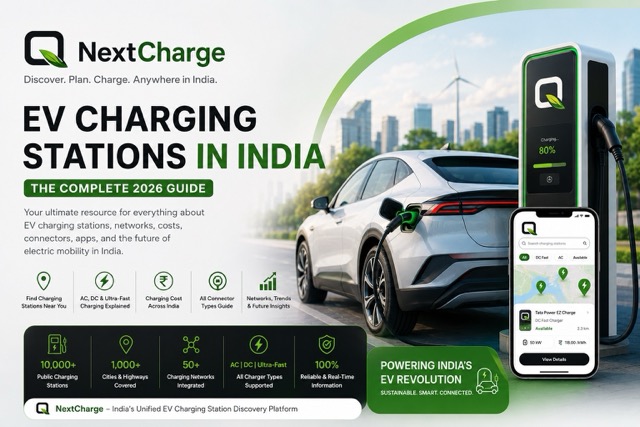
If you've driven an electric vehicle in India for more than a few months, you already know the real question isn't "should I buy an EV?" — it's "where do I charge it, and how much will it cost me?" That second question turns out to be more complicated than it should be, because India's EV charging infrastructure isn't one network. It's dozens of them — utility-run, startup-run, OEM-run — layered across cities, highways, and housing societies at very different stages of maturity.
This guide exists to answer that question properly, in one place, with real numbers rather than vague reassurance. We'll walk through how EV charging actually works, the difference between AC and DC charging (and why it matters more than most buyers realize), every connector type you'll encounter on Indian roads, what charging actually costs today, the charging networks operating in India, and where India's charging infrastructure is headed. Along the way, we'll explain where a platform like NextCharge — India's unified EV charging station discovery platform — fits into solving the most common frustration EV owners report: needing several different apps just to find a compatible, working charger.
Who this guide is for: current EV owners, people shopping for their first EV, fleet operators planning charging logistics, charging station operators and investors evaluating the market, and students or researchers who need an accurate, well-sourced primer on India's EV charging landscape.
What Is an EV Charging Station?
Definition: An EV charging station — also called EVSE (Electric Vehicle Supply Equipment) — is the hardware and connection point that transfers electricity from the power grid into an electric vehicle's battery. It can range from a simple wall-mounted socket in a home garage to a high-power DC fast-charging unit at a highway plaza capable of adding hundreds of kilometers of range in under an hour.
Every EV charging station, regardless of type, does the same fundamental job: it moves electrical energy, measured in kilowatt-hours (kWh), from the grid into the vehicle's battery, through a connector that physically plugs into the car.
Key Takeaway
An EV charging station is not just a plug — it's a piece of regulated electrical infrastructure with a specific power rating (kW), a specific connector standard, and (for public stations) a network operator, a pricing model, and often an app-based authentication system.
How EV Charging Works
Understanding how charging actually works explains almost every practical decision an EV owner has to make — including why some chargers are so much faster than others.
- Electricity from the grid arrives as AC (alternating current). Homes, offices, and most public slow chargers deliver power to your car as AC.
- Your car's battery stores energy as DC (direct current). Somewhere in the process, AC has to become DC.
- For AC charging, your car does the conversion. Every EV has an onboard charger — a small converter that turns incoming AC power into DC power the battery can store. This onboard charger has a maximum capacity (commonly 3.3 kW, 7.2 kW, or 11 kW in Indian EVs), which is the real bottleneck in AC charging speed, not the wall charger itself.
- For DC fast charging, the station does the conversion instead. A DC fast charger contains its own large-scale AC-to-DC converter and feeds DC power directly into the battery, bypassing the car's onboard charger entirely. This is why DC fast charging can be dramatically faster than AC charging — it isn't limited by the small converter inside the car.
Answer box: How does EV charging work? EV charging works by transferring electricity from the power grid into a vehicle's battery through a connector. AC charging relies on the car's onboard charger to convert AC power to DC; DC fast charging converts power at the station itself, allowing much higher charging speeds.
The Charging Curve
One detail most first-time EV buyers don't know: charging speed isn't constant. A battery charges fastest roughly between 10% and 60–80% state of charge, then slows down significantly as it approaches 100% — the same way a sponge absorbs water quickly at first and then more slowly as it nears saturation. This is why experienced EV owners on long trips typically charge to about 80% and move on, rather than waiting for a full 100%, which can take disproportionately longer.
Types of EV Chargers
India's charging infrastructure uses three broad categories of chargers, distinguished primarily by power output and charging speed.
AC Chargers (Level 1 & Level 2)
AC chargers are the slowest but most common type, typically used at home, at the workplace, or overnight.
- Portable/Level 1 AC: Around 3.3 kW, often usable from a standard 15A household socket. Common for two-wheelers and as an emergency backup for cars.
- Level 2 AC (wallbox): Typically 7.2 kW to 11 kW for home and workplace installations in India.
- Typical use case: Charging overnight at home, or during an 8+ hour workday at the office.
- Typical speed: Roughly 25–75 km of range added per hour, depending on the vehicle and charger.
DC Fast Chargers
DC fast chargers bypass the car's onboard charger and deliver power directly to the battery, making them significantly faster.
- Typical power range in India: 30 kW to 60 kW are the most commonly installed ratings in Indian cities today, though highway installations increasingly use 120 kW and 150 kW units. (Source: TelioEV, Nov 2025.)
- Typical charging time: A 20% to 80% charge typically takes 30 to 45 minutes on a suitable DC fast charger, depending on battery size and the charger's power rating. (Source: Pulse Energy, Apr 2026; TelioEV, Nov 2025.)
- Typical use case: Quick top-ups during a road trip, or fast turnaround for fleet and commercial vehicles.
Ultra-Fast Chargers
Ultra-fast chargers represent the highest end of DC fast charging.
- Typical power range: 120 kW to 400 kW, with most Indian highway deployments currently concentrated around 120–150 kW, and higher-powered units (240 kW+) expected to become more common as more Indian EVs adopt 400V and 800V battery architectures. (Source: TelioEV, Nov 2025; ZeroFootprint product specifications, 2025.)
- Important caveat: A charger's maximum power rating does not guarantee that speed for every vehicle. Your EV's own charge-acceptance rate is the real limit — a car that can only accept 60 kW will charge at roughly 60 kW even when plugged into a 350 kW ultra-fast charger. (Source: Pulse Energy, Apr 2026; Power Sonic, Oct 2025.)
Charger Type Comparison Table
| Charger Type | Typical Power | Typical Use | Approx. Charging Time (20–80%) |
|---|---|---|---|
| Portable / Level 1 AC | ~3.3 kW | Emergency/backup, 2-wheelers | 6–10+ hours |
| Level 2 AC (home/workplace) | 7.2–11 kW | Home, office, overnight | 4–8 hours |
| DC Fast Charger | 30–60 kW | Urban fast-charging, quick top-ups | 30–45 minutes |
| Ultra-Fast DC Charger | 120–400 kW | Highways, long-distance travel | 15–30 minutes |
Charging times are approximate and vary significantly by vehicle, battery size, state of charge, and ambient temperature.
Connector Types
Choosing a compatible connector is the single most important practical detail for any EV owner in India — plugging in the wrong connector type simply isn't physically possible, so knowing your car's connector before you search for a charger saves real time and frustration.
CCS2 (Combined Charging System 2)
CCS2 is the dominant DC fast-charging standard in India, used by most Indian and global EV manufacturers including Tata, Mahindra, Hyundai, Kia, MG, and BYD. (Source: TelioEV, Nov 2025.) It combines a Type 2 AC connector with two additional DC pins, allowing the same physical port to support both AC and DC charging. Power ratings for CCS2 range from around 50 kW up to a theoretical 350 kW, though most Indian public installations today sit well below that ceiling. (Source: 1C EV Charging; Power Sonic, Oct 2025.)
Type 2 AC
Type 2 is the standard AC charging connector used across most Indian EVs for home, workplace, and slower public charging. It's the "everyday" connector most EV owners use far more often than DC fast charging.
CHAdeMO
CHAdeMO is a DC fast-charging standard originally developed in Japan, used by a smaller number of EV models available in India (historically associated with certain Japanese-origin EVs).
GB/T
GB/T is a Chinese charging standard, relevant primarily for EVs and components with Chinese origin. It's less common in the mainstream Indian passenger EV market than CCS2, but still supported by some charger hardware and relevant for certain commercial vehicle segments.
Bharat AC001
Bharat AC001 is an Indian-developed AC charging standard, commonly used for entry-level and lower-cost electric vehicles in India's early EV charging infrastructure rollout.
Bharat DC001
Bharat DC001 is an Indian-developed DC charging standard that was used relatively widely in the early phase of India's EV charging infrastructure buildout. As CCS2 has become the dominant standard among major OEMs, Bharat DC001 usage has been gradually phased out in newer installations. (Source: TelioEV, Nov 2025.)
Connector Comparison Table
| Connector | Current (AC/DC) | Typical Power | Common Vehicles in India |
|---|---|---|---|
| CCS2 | DC (with AC capability) | 50–350 kW | Most modern Indian & global EVs (Tata, Mahindra, Hyundai, Kia, MG, BYD) |
| Type 2 | AC | Up to ~22 kW (typically 7.2–11 kW in India) | Nearly all Indian EVs for home/AC charging |
| CHAdeMO | DC | Varies | Select Japanese-origin EVs |
| GB/T | DC/AC | Varies | Chinese-origin EVs/components |
| Bharat AC001 | AC | Lower power | Entry-level EVs (early infrastructure) |
| Bharat DC001 | DC | Lower/mid power | Early-generation domestic EVs (declining use) |
Did You Know? The safest, most future-proof charger combination for new charging station investments in India today is Type 2 AC plus CCS2 DC — this is the pairing most infrastructure specialists now recommend, given how dominant CCS2 has become among major EV manufacturers. (Source: TelioEV, Nov 2025.)
Charging Speeds
"Charging speed" is really a function of three things working together: the charger's power rating, the car's onboard charger or DC charge-acceptance rate, and the battery's current state of charge. Understanding the interplay matters more than memorizing kW numbers.
| Charging Type | Range Added (approx.) | Best For |
|---|---|---|
| Level 1 AC (~3.3 kW) | ~10–15 km/hour | Emergency top-up, 2-wheelers |
| Level 2 AC (7.2–11 kW) | ~25–75 km/hour | Overnight home/workplace charging |
| DC Fast (30–60 kW) | 20–80% in 30–45 min | Urban quick charging |
| Ultra-Fast DC (120 kW+) | 20–80% in 15–30 min | Highway/long-distance travel |
(Ranges are approximate and vary by vehicle and battery size — see individual manufacturer specifications for exact figures.)
Charging Costs
This is the question almost every EV owner and prospective buyer actually cares about, and the honest answer is: it depends heavily on where you charge.
Home Charging Costs
Home (domestic) electricity tariffs in India typically range from roughly ₹4–10 per kWh, depending on the state, DISCOM (electricity distribution company), and consumption slab. (Sources: Bolt.Earth, Dec 2025; Desi Utility, May 2026; Chargze, 2026.) On a typical mid-size EV, a full home charge often costs somewhere in the ₹250–450 range, translating to roughly ₹1–1.5 per kilometer driven. (Source: Zevpoint, Feb 2026.)
Public AC Charging Costs
Public Level 2/AC charging in India typically costs ₹8–18 per kWh, depending on the operator, city, and station type. (Sources: Bolt.Earth, Dec 2025; Hydromo, May 2026.)
Public DC Fast Charging Costs
Public DC fast charging is the most expensive option, typically ranging from ₹15–26 per kWh, with some premium or high-demand stations pricing above that range. (Sources: Bolt.Earth, Dec 2025; ChargeZone, media page; Desi Utility, May 2026.) As one example, ChargeZone has publicly stated its own public charger rates typically fall between ₹18 and ₹25 per unit, shown upfront in its app. (Source: ChargeZone, "EV Charging Costs in India" media page.)
Cost Comparison Table
| Charging Location | Typical Cost per kWh (₹) | Notes |
|---|---|---|
| Home (domestic tariff) | ₹4–10 | Cheapest option; varies by state/DISCOM/slab |
| Public AC / Level 2 | ₹8–18 | Includes operator service charges |
| Public DC Fast Charging | ₹15–26 | Fastest but most expensive per unit; premium sites can be higher |
Key takeaway: Home charging is typically the cheapest way to charge an EV in India — often roughly a third to half the per-kilometer cost of public DC fast charging. Most EV owners are best served by doing the large majority of their charging at home or work, and reserving public DC fast charging for longer trips or top-ups when away from home. (Synthesis based on Bolt.Earth, Dec 2025; Hydromo, May 2026.)
Worked Example
A Tata Nexon EV with a roughly 30–40 kWh battery, charged at a home tariff of ₹8/kWh, costs approximately ₹240–360 for a full charge — working out to well under ₹1 per kilometer for many owners. The same charge session on a public DC fast charger, at ₹18–25/kWh, could cost roughly ₹550–900 for a comparable amount of energy. (Sources: Zevpoint, Feb 2026; ChargeZone media page; Desi Utility, May 2026.) The exact numbers depend on your specific battery size, local tariff, and charging losses (commonly estimated at 6–15%), so treat this as an illustrative example rather than a quote for your specific vehicle.
Public Charging, Home Charging, Workplace Charging & Highway Charging
Not all charging happens the same way or serves the same purpose. Understanding the four main charging contexts helps explain why India's infrastructure is built the way it is.
Public Charging
Public charging stations — installed by charge point operators (CPOs) in locations like malls, parking lots, office parks, and standalone charging plazas — are designed for EV owners who don't have reliable home charging access, or who need a top-up while away from home. Public charging is generally more expensive than home charging because operators must recover the cost of land, hardware, grid connections, maintenance, and software. (Source: Bolt.Earth, Dec 2025.)
Home Charging
Home charging — typically a Level 2 AC wallbox installed in a private garage or parking spot — remains the cheapest and most convenient charging method for owners who have access to it. For daily commuters covering typical urban distances, overnight home charging comfortably covers most needs.
Workplace Charging
Workplace charging serves a similar function to home charging: EVs parked for 8+ hours during a workday can charge fully on relatively low-power AC chargers, making high-speed DC charging unnecessary at most offices. Business parks and corporate campuses are increasingly deploying Level 2 AC infrastructure for exactly this reason. (Source: TelioEV, Nov 2025.)
Highway Charging
Highway charging is where DC fast and ultra-fast chargers matter most. Long-distance EV travel in India depends on charging stations spaced at reasonable intervals along major highways and expressways, with enough power to make a meaningful top-up in a reasonable stop time. This is also the segment of India's charging infrastructure that has historically lagged urban charging, and where most government infrastructure schemes — discussed later in this guide — are specifically targeted.
Best Charging Networks in India
India's public charging landscape is run by a mix of utility-backed operators, independent startups, and OEM-linked networks. Here's an overview of the major players.
Tata Power (EZ Charge)
Tata Power's EZ Charge network is among the largest and most widely distributed charging networks in India, with a strong presence across most major Indian cities and highway corridors. It is one of the partner networks integrated into the TATA.ev Mega Charger ecosystem alongside several other operators. (Source: Tata Power/Tata Motors press materials, 2026.)
Statiq
Statiq is an independent Indian charge point operator with a strong footprint in premium and commercial locations, particularly in and around Delhi NCR, and is also a TATA.ev Mega Charger partner network. (Source: Tata Motors press release.)
ChargeZone
ChargeZone operates public DC fast-charging infrastructure across multiple Indian states, with published public charger rates typically in the ₹18–25 per unit range, and is a TATA.ev Mega Charger partner network. (Source: ChargeZone media page; Tata Motors press release.)
Bolt.Earth
Bolt.Earth operates EV charging infrastructure and also publishes widely cited consumer research and cost-guide content on EV charging economics in India (used as a source throughout this article).
Kazam
Kazam is notable in the Indian charging landscape for offering a public developer REST API — a comparatively rare feature among major Indian CPOs, most of which require direct bilateral partnerships rather than offering open API access.
Ather Grid
Ather Grid is the charging network operated by Ather Energy, historically focused on supporting Ather's own electric two-wheelers, with charging points concentrated in cities where Ather has a strong two-wheeler customer base.
Jio-bp Pulse
Jio-bp Pulse is the EV charging network backed by the Jio-bp joint venture (Reliance Jio and bp), leveraging bp's fuel retail network and Jio's infrastructure reach.
GLIDA
GLIDA (formerly operating under the Fortum Charge & Drive brand in India) is another established charging network and TATA.ev Mega Charger partner. (Source: Tata Motors press release.)
Charging Network Snapshot Table
| Network | Type | Known For |
|---|---|---|
| Tata Power EZ Charge | Utility-backed | One of India's largest and most widely distributed networks |
| Statiq | Independent | Strong presence in premium/commercial Delhi NCR locations |
| ChargeZone | Independent | Multi-state DC fast-charging network; published transparent per-unit pricing |
| Bolt.Earth | Independent | Charging infrastructure + widely cited consumer research |
| Kazam | Independent | Rare public developer API among major Indian CPOs |
| Ather Grid | OEM-linked | Built around Ather's own two-wheeler ecosystem |
| Jio-bp Pulse | JV-backed | Backed by Reliance Jio and bp's fuel retail network |
| GLIDA | Independent | Established multi-city network, TATA.ev partner |
Important disclaimer: Individual network coverage, pricing, and station counts change frequently. This table is a directional overview, not a live, continuously updated dataset — always check each operator's own app for current pricing and station availability before a trip.
How to Find EV Charging Stations
There are three broad approaches EV owners in India use today to find a charging station:
- Each network's own app. Tata Power EZ Charge, Statiq, ChargeZone, and others each maintain their own app showing only their own stations. This is reliable for that specific network's coverage but requires installing multiple apps to see the full picture.
- General-purpose map apps. Broader map and navigation tools sometimes show charging station pins, but coverage and up-to-dateness vary and are not purpose-built for EV-specific needs like connector-type filtering.
- A unified, multi-network discovery app. This is the category NextCharge belongs to — an approach built specifically to search across multiple charging networks from one place, rather than requiring a separate app per operator.
Role of NextCharge
NextCharge is India's unified EV charging station discovery platform — a pre-seed-stage startup built specifically to address the fragmentation described above. Rather than operating its own physical charging hardware, NextCharge focuses on the discovery layer: helping EV drivers search, compare, and navigate to charging stations across multiple Indian charge point operators (including networks like Statiq, Tata Power EZ Charge, ChargeZone, Ather Grid, and Kazam) from a single app.
Current focus: NextCharge's core product direction is charging station discovery — a nearby-station finder, connector-type and charging-speed filtering, and multi-network search — built to reduce the need to check several separate CPO apps for a single trip.
Future roadmap (not yet live): Real-time live charger availability, in-app booking of charging slots, and unified cross-network payments are part of NextCharge's longer-term vision, but are not currently available features. Building them depends on deeper data integration with individual CPOs, many of which currently require direct partnerships rather than offering public APIs.
Benefits of Using NextCharge
- One search across multiple networks, instead of checking several CPO apps individually.
- Consistent, comparable station information — connector type, network, and charging speed presented the same way regardless of which operator supplied the underlying data.
- A platform built specifically around India's charging ecosystem, rather than a generic global map tool retrofitted for EV use.
- A foundation that grows more useful as India's charging network expands — the more operators and stations there are, the more value an aggregator like NextCharge provides relative to checking each network separately.
Government Initiatives
India's public charging infrastructure has been shaped substantially by national policy, not just private investment. Here are the major programs every serious reader of this topic should know.
FAME-II (2019–2024)
FAME-II (Faster Adoption and Manufacturing of Electric Vehicles, Phase II) provided approximately ₹11,500 crore in budgetary support and supported roughly 16.72 lakh EVs, alongside funding for public charging infrastructure — figures for the exact number of chargers installed under the scheme vary slightly across sources but are generally cited in the range of roughly 8,900–9,300 public chargers. (Sources: ANI, Jul 2026; imarcengineering.com, Jan 2026.)
PM E-DRIVE (October 2024 – March 2026)
PM E-DRIVE is the successor scheme, with ₹2,000 crore allocated specifically for public charging infrastructure, targeting approximately 72,300 new public charging stations across 50 national highway corridors. This breaks down into roughly 22,100 DC fast chargers for cars, roughly 48,400 chargers for electric two- and three-wheelers, and roughly 1,800 e-bus charging stations. Under the scheme, Category A sites (government offices, hospitals, colleges) receive 100% subsidy, while Category B sites (airports, metro/bus stations, fuel outlets, and toll plazas) receive 80% infrastructure subsidy and 70% equipment subsidy. (Sources: PIB / Ministry of Heavy Industries, Sep–Oct 2025; Bolt.Earth, Jan 2026.)
Ministry of Power Charging Infrastructure Guidelines
The Ministry of Power's charging infrastructure guidelines (first issued in 2022, subsequently amended) enable home and office self-charging on existing electricity connections without requiring a separate license, provide for concessional-rate land allocation to public charging station operators, and have historically capped the single-part EV tariff at the Average Cost of Supply. (Source: PIB, 2024.)
Bureau of Energy Efficiency (BEE)
BEE serves as the central nodal agency coordinating public charging infrastructure rollout, working alongside the Ministry of Power, state nodal agencies, and oil-marketing companies. A national interoperable charging-roaming initiative has also been reported in beta stages as of 2026. (Sources: graphaize.com, Oct 2025; MeraEV, May 2026.)
Government Initiatives at a Glance
| Scheme/Body | Period | Focus | Key Figures |
|---|---|---|---|
| FAME-II | 2019–2024 | EV adoption + charging infra | ₹11,500 cr; ~16.72 lakh EVs; ~8,900–9,300 chargers |
| PM E-DRIVE | Oct 2024–Mar 2026 | Highway charging corridors | ₹2,000 cr; ~72,300 target stations across 50 corridors |
| MoP Charging Guidelines | 2022–ongoing | Regulatory framework | Self-charging rights, land allocation, tariff caps |
| BEE | Ongoing | National coordination | Nodal agency for public charging rollout |
Charging Infrastructure Growth
India's public EV charging station count has grown substantially over the past few years, though it's worth noting that different government releases report somewhat different totals depending on release date and counting methodology (installed vs. operational vs. individual charge points).
| Period | Public Charging Stations (Cumulative) | Source |
|---|---|---|
| March 2023 | ~6,586 | PIB/Lok Sabha |
| February 2024 | ~12,146 | PIB/Lok Sabha |
| March 2025 | ~26,367 | PIB/Lok Sabha |
| August 2025 | ~29,277 | Ministry of Power |
| March 2026 | 27,737 installed / 22,753 operational | Parliament data, cited in mmcm.in |
| July 2026 | 52,718 (incl. 16,561 fast chargers) | Government reply to Lok Sabha (ANI) |
Despite this growth, India's charger-to-EV ratio remains around 1 public charger per 235 EVs on the road as of early 2026 — well behind the global benchmark range of roughly 1:6 to 1:20. (Source: mmcm.in, May 2026, citing ORF/CII analysis.) Independent assessments also suggest that around 18% of installed public stations are non-operational at any given time, due to factors including grid issues, low utilisation undermining maintenance economics, and payment or service failures. (Source: mmcm.in, May 2026.)
Infrastructure remains geographically concentrated: the top five states account for roughly 60% of India's installed public charging base, and the top ten states for roughly 85%, leaving most states and Union Territories comparatively underserved. (Sources: DIYguru, Feb 2026; E-Vehicle Info, Apr 2026.)
Expert insight: The gap between "stations installed" and "stations actually working when you arrive" is arguably a bigger practical problem for EV owners today than the headline growth numbers suggest — which is one reason discovery tools that surface reliable, comparable information (rather than just raw pin counts) matter as much as the physical rollout itself.
Challenges
India's EV charging ecosystem, despite rapid growth, still faces several structural challenges:
- Fragmentation across operators. Dozens of independent CPOs each run separate apps, with no single dominant network covering the whole country — the core problem this guide (and NextCharge) is built around.
- Non-operational stations. An estimated 18% of installed public stations are non-functional at any given time, meaning raw station counts overstate real-world availability. (Source: mmcm.in, May 2026.)
- Uneven geographic distribution. Charging infrastructure is heavily concentrated in a handful of states, leaving large parts of the country thinly served. (Sources: DIYguru, Feb 2026; E-Vehicle Info, Apr 2026.)
- Grid and land constraints. High-power DC fast charging requires substantial grid capacity and suitable land, both of which are harder to secure in dense urban cores.
- Limited public API access. Most major Indian CPOs do not offer open developer APIs, requiring direct commercial partnerships for any third-party integration or aggregation effort — a real, practical barrier for the broader ecosystem, not just for any one company.
- Standard fragmentation, though improving. With CCS2 emerging as the dominant DC standard among major OEMs, connector compatibility issues are decreasing over time, but older Bharat DC001 installations and mixed-standard fleets still create friction in some segments. (Source: TelioEV, Nov 2025.)
Future of EV Charging in India
Several trends point toward where India's charging ecosystem is heading:
- Continued highway corridor buildout, driven by PM E-DRIVE's 50-corridor, 72,300-station target through March 2026.
- Rising DC fast-charger power ratings, as more Indian EVs adopt 400V and increasingly 800V battery architectures capable of accepting higher charging speeds. (Source: TelioEV, Nov 2025.)
- Growing interoperability efforts, including national roaming initiatives coordinated by BEE, intended to make it easier for a single account or app to work across multiple networks. (Source: MeraEV, May 2026.)
- Emerging open API standards, such as the Beckn Protocol-based Unified Energy Interface (UEI), which — if broadly adopted — could substantially lower the technical barrier for aggregation platforms to integrate directly with multiple CPOs.
- Growing role for aggregation and discovery platforms like NextCharge, as the number of networks and stations continues to grow faster than any single app's own coverage.
Frequently Asked Questions
1. What is an EV charging station?
An EV charging station (EVSE) is hardware that transfers electricity from the grid into an electric vehicle's battery through a connector, ranging from simple home wallboxes to high-power public DC fast chargers.
2. How does EV charging work?
AC charging relies on the car's onboard charger to convert grid AC power to DC; DC fast charging converts power at the station itself and feeds DC directly to the battery, enabling much faster charging.
3. What is the difference between AC and DC charging?
AC charging is slower and limited by the car's onboard charger (typically 3.3–11 kW in India); DC charging bypasses that limit and can deliver 30 kW to 350+ kW directly to the battery.
4. What is CCS2?
CCS2 (Combined Charging System 2) is the dominant DC fast-charging connector standard in India, used by most major Indian and global EV manufacturers, with power ratings from around 50 kW up to a theoretical 350 kW.
5. What is a Type 2 charger?
Type 2 is the standard AC charging connector used for home, workplace, and slower public charging across most Indian EVs.
6. What is Bharat DC001?
Bharat DC001 is an Indian-developed DC charging standard used relatively widely in the early phase of India's EV charging infrastructure, now gradually being phased out as CCS2 has become dominant among major OEMs.
7. What is Bharat AC001?
Bharat AC001 is an Indian-developed AC charging standard, commonly used for entry-level electric vehicles.
8. What is CHAdeMO?
CHAdeMO is a DC fast-charging standard originally developed in Japan, used by a smaller number of EV models available in India.
9. What is GB/T charging?
GB/T is a Chinese EV charging standard relevant primarily to EVs and components of Chinese origin.
10. How much does it cost to charge an EV at home in India?
Home charging typically costs ₹4–10 per kWh depending on your state and electricity slab, often working out to roughly ₹1–1.5 per kilometer driven.
11. How much does public DC fast charging cost in India?
Public DC fast charging in India typically costs ₹15–26 per kWh, making it more expensive per unit than home charging but much faster.
12. Is home charging cheaper than public charging?
Yes. Home charging is typically the cheapest way to charge an EV in India, often costing roughly a third to half as much per kilometer as public DC fast charging.
13. How long does it take to charge an EV in India?
Home AC charging typically takes 4–8+ hours for a substantial charge, while DC fast charging can take an EV from 20% to 80% in roughly 30–45 minutes, and ultra-fast charging can do the same in 15–30 minutes.
14. What is an ultra-fast charger?
An ultra-fast charger is a high-power DC charger, typically rated 120 kW to 400 kW, designed for rapid highway and long-distance charging.
15. Does a 350 kW charger always charge my car at 350 kW?
No. Your EV's own charge-acceptance rate limits actual charging speed — a car that can only accept 60 kW will charge at roughly 60 kW even on a 350 kW charger.
16. What is the best charger combination for a new charging station in India?
Type 2 AC paired with CCS2 DC is currently considered the safest, most future-proof combination for new Indian charging station installations, given CCS2's dominance among major EV manufacturers.
17. What are the major EV charging networks in India?
Major networks include Tata Power EZ Charge, Statiq, ChargeZone, Bolt.Earth, Kazam, Ather Grid, Jio-bp Pulse, and GLIDA, among others.
18. What is NextCharge?
NextCharge is India's unified EV charging station discovery platform, built to help EV drivers search and compare charging stations across multiple networks — including Statiq, Tata Power EZ Charge, ChargeZone, Ather Grid, and Kazam — from one app.
19. Does NextCharge operate its own charging stations?
No. NextCharge does not build or operate physical charging hardware; it focuses on charging station discovery across existing networks.
20. Does NextCharge show real-time charger availability?
Real-time live charger availability is part of NextCharge's future roadmap, not a currently available feature.
21. Can I book a charging slot through NextCharge?
In-app booking is a planned future feature for NextCharge and is not currently available.
22. Can I pay for charging inside the NextCharge app across all networks?
Unified cross-network payment is part of NextCharge's future vision, not a current capability.
23. What government schemes support EV charging in India?
Major schemes include FAME-II (2019–2024) and its successor PM E-DRIVE (Oct 2024–Mar 2026), alongside Ministry of Power charging infrastructure guidelines and BEE's coordination role.
24. How many public EV charging stations does India have?
According to a government reply to the Lok Sabha reported in July 2026, India has 52,718 public EV charging stations, including 16,561 with fast chargers for cars — though earlier 2026 data put installed vs. operational stations at 27,737 and 22,753 respectively, so figures vary by release and methodology.
25. What is India's charger-to-EV ratio?
As of early 2026, India has roughly 1 public charger per 235 EVs on the road, compared to a global benchmark range of roughly 1:6 to 1:20.
26. Are all installed charging stations in India actually working?
No. Independent estimates suggest around 18% of installed public charging stations in India are non-operational at any given time.
27. Which Indian states have the most EV charging stations?
Charging infrastructure is concentrated in a handful of states, with the top five states accounting for roughly 60% of the installed base and the top ten for roughly 85%, as of recent government data.
28. What is PM E-DRIVE?
PM E-DRIVE is a government scheme (Oct 2024–Mar 2026) allocating ₹2,000 crore for public charging infrastructure, targeting around 72,300 new stations across 50 national highway corridors.
29. What is FAME-II?
FAME-II (2019–2024) was a government scheme providing roughly ₹11,500 crore in support for EV adoption and charging infrastructure, supporting around 16.72 lakh EVs.
30. What does BEE do for EV charging in India?
The Bureau of Energy Efficiency (BEE) acts as the central nodal agency coordinating India's public charging infrastructure rollout alongside the Ministry of Power and state agencies.
31. Why are there so many different EV charging apps in India?
Because India's charging market developed through many independent charge point operators rather than one national network, each running its own app — the specific fragmentation problem aggregator platforms like NextCharge are built to address.
32. How do I find EV charging stations near me?
You can check individual CPO apps (like Tata Power EZ Charge or Statiq), general map apps, or a unified discovery platform like NextCharge that's built to search across multiple networks at once.
33. Is DC fast charging bad for my EV's battery?
Frequent, exclusive reliance on DC fast charging can accelerate battery degradation compared to predominantly AC charging, which is one reason most manufacturers recommend AC charging for daily use and DC fast charging mainly for longer trips.
34. Should I charge my EV to 100% every time?
Not necessarily. Charging typically slows significantly above 80% state of charge, and many EV owners charge to around 80% for daily use, reserving a full 100% charge for longer trips where maximum range is needed.
35. What's the difference between a charging network and a charging station?
A charging station is a single physical charging point or location; a charging network is the company (CPO) that owns, operates, and manages many charging stations, typically through its own app.
36. Can any EV use any public charging station in India?
Only if the station's connector type matches the vehicle's connector — for example, a CCS2-only station can't physically charge a vehicle that only supports CHAdeMO or GB/T.
37. What is a CPO?
CPO stands for Charge Point Operator — a company that owns and operates EV charging stations, such as Tata Power EZ Charge, Statiq, or ChargeZone.
38. Do I need a different app for every charging network in India?
Today, largely yes, unless you use a discovery platform like NextCharge that's built to aggregate multiple networks into a single search.
39. What is EVSE?
EVSE stands for Electric Vehicle Supply Equipment — the technical term for any EV charging station or charger, from a home wallbox to a public DC fast charger.
40. How is charging cost calculated?
Charging cost is calculated by multiplying your vehicle's battery capacity (in kWh) by your applicable electricity rate (₹ per kWh), then adjusting for charging losses, typically estimated at 6–15%.
Conclusion
India's EV charging landscape in 2026 is a story of genuine progress alongside genuine fragmentation. Public charging stations have grown many times over in just a few years, government schemes like PM E-DRIVE are actively targeting the highway-corridor gaps that matter most for long-distance travel, and standards like CCS2 are steadily converging the market toward simpler compatibility. At the same time, the sheer number of independent charging networks — each with its own app — remains the single most common practical frustration EV owners report, and it's a problem that infrastructure growth alone won't solve.
That's precisely the gap NextCharge, India's unified EV charging station discovery platform, is built to close — not by adding more physical chargers to the grid, but by making the ones that already exist, across every major network, actually findable and comparable from one place.
Tired of checking five different apps just to find a working charger? Follow NextCharge for updates as India's unified EV charging discovery platform comes online, or get in touch for charge point operator and business partnership inquiries.